
Teller County Release Date Meaning
A projected release date is an estimate. An actual release date is the point when the person leaves a custody setting or is reported as released by the responsible agency. In Teller County, the local jail setting and the state prison setting use different terms. The Teller County Detention Center detail view can include a """Schedule Release Date""" field. CDOC profiles use statewide time-computation terms such as Est. Parole Eligibility Date, Next Parole Hearing Date, Est. Mandatory Release Date, and Est. Sentence Discharge Date.
The distinction matters most for people awaiting trial. A pretrial detainee may be released by posted bond, personal recognizance order, dismissal, court order, transfer, or another agency hold. That person may not have a sentence-computation date at all. A sentenced prison inmate is different: CDOC computes dates under Colorado law, sentence credits, parole rules, and mandatory parole requirements.
Find a Teller County Release Date
The first step is to match the person to the correct custody system. A Teller County jail release is not the same as a CDOC prison release. A probation discharge is a court and probation record. A federal sentence uses federal sources. Use the shortest path that fits the facts, then verify with the record holder if the date affects court, travel, family coordination, or supervision planning.
- Check the Teller Tiger recent-release feed for recent jail releases and open the detail record for the """Schedule Release Date""" field, booking number, booking date, arresting agency, and charge table.
- If the person is still on the active roster, treat the release as unconfirmed by the online jail feed and use the jail information request path or 719-687-7770.
- Search the Teller County court page and docket tools for bond orders, dismissals, sentencing, probation, mittimus, or next hearing dates.
- Use CDOC Offender Search if a Teller case produced a Colorado prison sentence or parole status.
- Use VINE Inmate Check for release or transfer alerts before the event, then confirm the date with the originating record.
- Use BOP or ICE only when the record points to federal custody, a federal sentence, or immigration detention.
Teller Jail Scheduled Date
The Teller County jail context is short term and court driven. The county detentions page says inmates are awaiting sentencing, trial, or transfer and are not long-term inmates. Many local exits therefore come from bond, recognizance release, a court hearing, a time-served sentence, dismissal, probation placement, transfer to CDOC, another county, federal custody, or ICE custody. The jail release date is a local custody fact; it does not always mean the criminal case is over.
The Tiger detail page may contain """Schedule Release Date,""" but research found at least one recent-release detail where that field was N/A. That means the field exists as part of the booking detail layout, not as a guaranteed release forecast. When the field is blank or N/A, use the court docket, jail information request form, and sheriff records request to confirm the expected or actual release date.
| Local clue | How to read it |
|---|---|
| Active roster | The person is still listed in jail custody unless the record is stale or mistaken. |
| Released Last 72hrs | The person appears in Teller's recent-release bucket, but exact release time and reason may still need confirmation. |
| Schedule Release Date | A detail-page field that may be N/A; verify before treating it as a firm date. |
| Court docket | The durable source for bond orders, sentencing, probation, dismissal, or transfer orders. |
CDOC Release Date Fields
For a Teller County case that leads to state prison, CDOC becomes the release-date system. The public search accepts DOC number, last name, first name, and gender. CDOC search tips say the DOC number is the primary identification number, up to six numeric characters, and that name searches return names beginning with the entered letters. Hyphenated last names should be searched without the hyphen, and the name may reflect the arresting or prosecuted name rather than a later legal name.
| CDOC field | Release-date meaning |
|---|---|
| Est. Parole Eligibility Date | The first eligibility or review timing under statute, not a promise of parole. |
| Next Parole Hearing Date | A hearing timing cue. It is not the date of release. |
| Est. Mandatory Release Date | The public CDOC field closest to a projected prison release date. |
| Est. Sentence Discharge Date | The estimated end of the sentence, which may follow prison release and mandatory parole. |
CDOC profiles can also show current facility assignment and conviction information. If the person is still assigned to a facility, the date may be projected. If the record shows release, discharge, or parole status, use the CDOC profile and parole records to understand whether the person is out of prison but still on supervision.
Colorado Earned-Time Rules
Colorado release-date computation rests on statutes, offense dates, sentence structure, credits, parole decisions, and changes in law. C.R.S. 17-22.5-405 governs earned time for many current sentence structures. The research notes a general earned-time limit of up to ten days per month of incarceration or parole, plus a separate provision allowing up to twelve days per month for specified lower-level felony and drug felony inmates who meet program and disciplinary criteria.
C.R.S. 17-22.5-403 governs parole eligibility for many post-1993 felony sentences. Proposition 128, approved in 2024, changed the truth-in-sentencing landscape for certain crimes of violence committed on or after January 1, 2025 by increasing required prison time before discretionary parole or earned-time reductions. The practical point for a Teller County release date lookup is simple: a violent-offense sentence, a nonviolent sentence, and an older sentence may compute differently.
The earned-time statute is one of the key sources for Colorado sentence calculation.
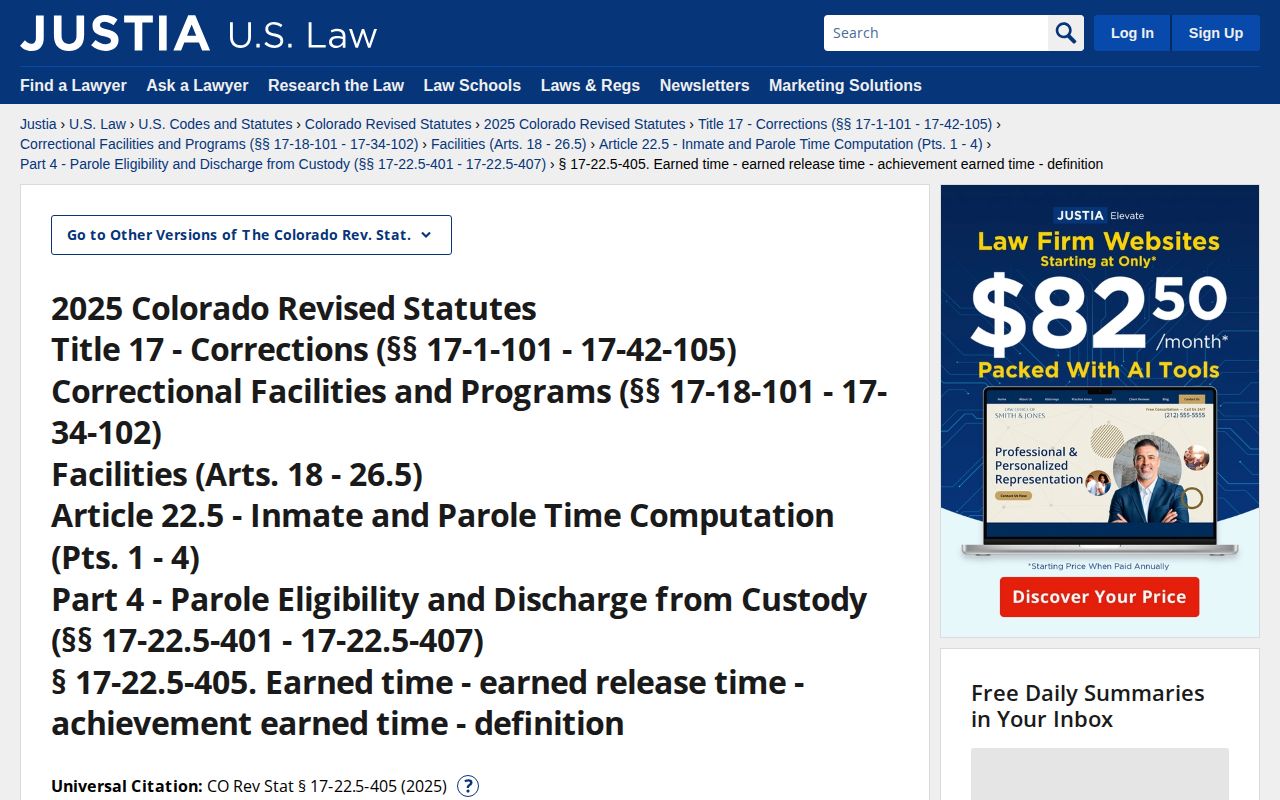
Use the statute to understand the type of credit, but use CDOC records for the person-specific computation.
Release to Mandatory Parole
A CDOC release is often not the end of all correctional control. Under C.R.S. 18-1.3-401, mandatory parole follows release by the State Board of Parole or sentence discharge pursuant to law and may not be waived or suspended by the court. That means a person may leave prison and still be under parole conditions.
The release-date lookup should therefore separate three dates: physical release from a prison bed, parole supervision status, and sentence discharge. The Teller court docket remains useful for the conviction and sentence, but the CDOC profile and parole records are the state source for prison release and post-release supervision. For more on the supervision side, use Post-Release Supervision.
Why Teller Release Dates Change
A release date can move for legal, custody, and administrative reasons. Teller County jail dates may change quickly because bond status, court orders, electronic monitoring, transport, another hold, or a transfer can alter the release process. CDOC dates can change when credits are added or removed, a parole decision changes, or a sentence is recalculated.
| Change factor | Possible effect |
|---|---|
| Earned time granted or withdrawn | Can move a CDOC estimated mandatory release or sentence discharge date. |
| Parole grant, denial, deferral, or rescission | Can change when prison release happens or whether release waits until the mandatory release date. |
| New conviction or consecutive sentence | Can extend the overall time-computation record. |
| Corrected presentence confinement credit | Can change the amount of time credited against a sentence. |
| Bond or court order changes | Can create, delay, or cancel a county jail release. |
| Hold, detainer, or transfer | Can mean the person leaves Teller custody but enters another agency's custody. |
Teller Bond Release Timing
Teller's bond notice gives a concrete local timing rule. The sheriff generally must release a defendant within six hours after qualifying recognizance or cash-bond conditions are met, unless extraordinary circumstances exist. If electronic monitoring must be fitted, the jail may hold up to 24 hours. Bonds can be posted at the Sheriff's Office 24 hours a day and through online bonding.
That rule is not the same as a CDOC projected release date. It is a county bond-processing rule for a person who is otherwise eligible for release. Fees, booking fees, and debts are not required to secure release on money bond under the Teller notice, although certain fees may be charged as debt after release. If the person does not appear in the recent-release feed right away, verify by phone, court docket, or records request instead of assuming the bond failed.
Note: A local jail release can be followed by probation, parole, transfer, or a new agency hold.
Public Record Search
Sponsored Results